


An Introduction to Graph Theory
Learning Outcome Understand crucial concepts of Graph Theory. Learn about various graphs and their properties. Deepen your knowledge on graph …
4.7
4.7 Rating ( 2 Reviews )  21 Students
Bestseller
Great Service
Highly Rated
Trending


Course Curriculum
| Course Promo | |||
| Graph Theory Promo | 00:02:00 | ||
| Module 01: Supplements | |||
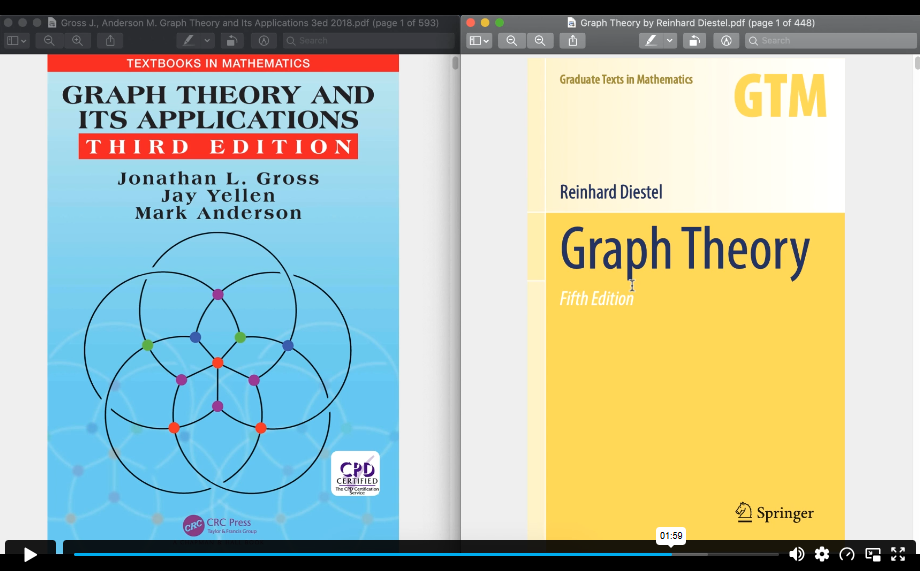
| Textbook Recommendations | 00:02:00 | ||
| Tools and Softwares | 00:05:00 | ||
| Sets | 00:09:00 | ||
| Number Sets | 00:10:00 | ||
| Parity | 00:12:00 | ||
| Terminologies | 00:07:00 | ||
| Module 02: Fundamentals | |||
| Introduction | 00:03:00 | ||
| Graphs | 00:11:00 | ||
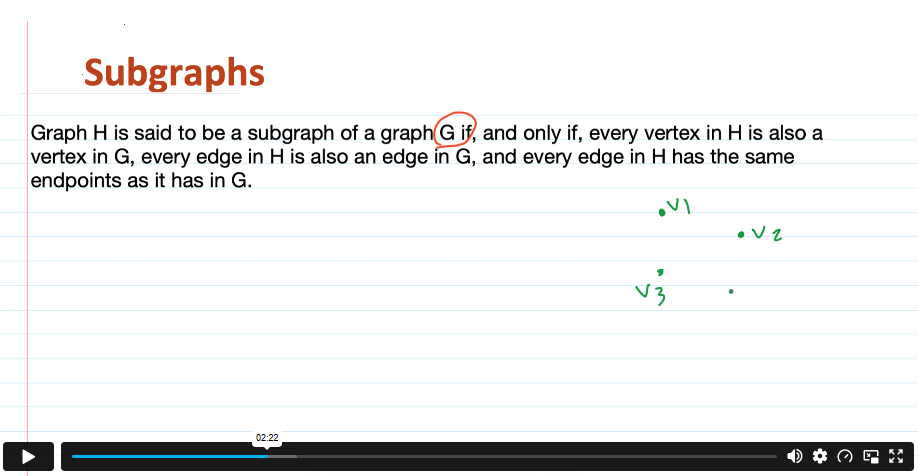
| Subgraphs | 00:09:00 | ||
| Degree | 00:10:00 | ||
| Sum of Degrees of Vertices Theorem | 00:23:00 | ||
| Adjacency and Incidence | 00:09:00 | ||
| Adjacency Matrix | 00:16:00 | ||
| Incidence Matrix | 00:08:00 | ||
| Isomorphism | 00:08:00 | ||
| Module 03: Paths | |||
| Introduction | 00:01:00 | ||
| Walks, Trails, Paths, and Circuits | 00:13:00 | ||
| Examples | 00:10:00 | ||
| Eccentricity, Diameter, and Radius | 00:07:00 | ||
| Connectedness | 00:20:00 | ||
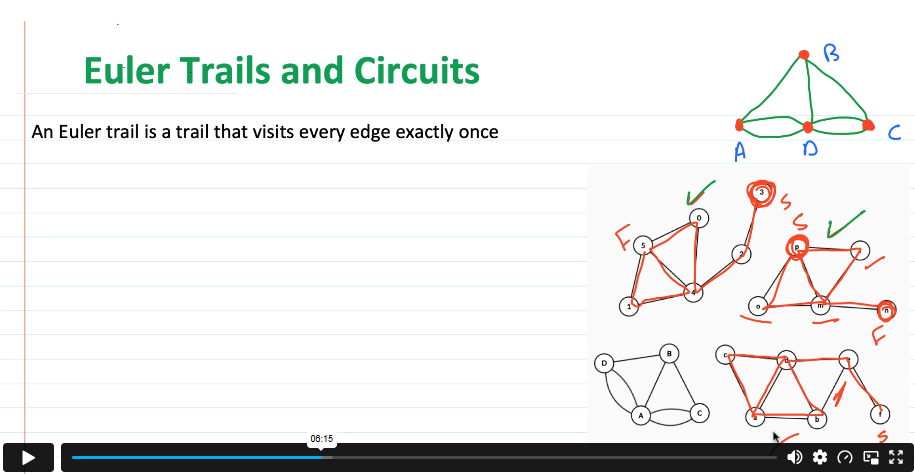
| Euler Trails and Circuits | 00:18:00 | ||
| Fleury’s Algorithm | 00:10:00 | ||
| Hamiltonian Paths and Circuits | 00:06:00 | ||
| Ore’s Theorem | 00:14:00 | ||
| Dirac’s Theorem | 00:06:00 | ||
| The Shortest Path Problem | 00:16:00 | ||
| Module 04: Graph Types | |||
| Introduction | 00:01:00 | ||
| Trivial, Null and Simple Graphs | 00:10:00 | ||
| Regular Graphs | 00:10:00 | ||
| Complete, Cycles and Cubic Graphs | 00:10:00 | ||
| Path, Wheel and Platonic Graphs | 00:11:00 | ||
| Bipartite Graphs | 00:14:00 | ||
| Module 05: Trees | |||
| Introduction | 00:01:00 | ||
| Trees | 00:14:00 | ||
| Cayley’s Theorem | 00:03:00 | ||
| Rooted Trees | 00:10:00 | ||
| Binary Trees | 00:14:00 | ||
| Binary Tree Traversals | 00:18:00 | ||
| Binary Expression Trees | 00:09:00 | ||
| Binary Search Trees | 00:19:00 | ||
| Spanning Trees | 00:10:00 | ||
| Forest | 00:07:00 | ||
| Module 06: Digraphs and Tournaments | |||
| Introduction | 00:01:00 | ||
| Digraphs | 00:12:00 | ||
| Degree | 00:09:00 | ||
| Isomorphism | 00:08:00 | ||
| Adjacency Matrix | 00:10:00 | ||
| Incidence Matrix | 00:05:00 | ||
| Walks, Paths and Cycles | 00:12:00 | ||
| Connectedness | 00:05:00 | ||
| Tournaments | 00:08:00 | ||
| Module 07: Planar Graphs | |||
| Introduction | 00:01:00 | ||
| Planar Graphs | 00:10:00 | ||
| Kuratowski’s Theorem | 00:14:00 | ||
| Euler’s Formula | 00:10:00 | ||
| Dual Graphs | 00:11:00 | ||
| Module 08: Graph Operations | |||
| Introduction | 00:01:00 | ||
| Vertex and Edge Deletion & Addition | 00:08:00 | ||
| Cartesian Product | 00:10:00 | ||
| Graph Join and Transpose | 00:04:00 | ||
| Complement Graphs | 00:05:00 | ||
| Module 09: Graph Colourings | |||
| Introduction | 00:01:00 | ||
| Vertex Colourings | 00:05:00 | ||
| Edge Colourings | 00:09:00 | ||
| Total Colourings | 00:05:00 | ||
| Assignment | |||
| Assignment – An Introduction to Graph Theory | 00:00:00 | ||

Course Reviews
No Reviews found for this course.
1. What is graph theory used for? +
It is used in computer science, networks, algorithms, and data analysis.
2. Is this course suitable for beginners? +
Yes, it starts from basic concepts and builds step-by-step understanding.
3. Do I need advanced maths knowledge? +
No, basic mathematical skills are enough to begin learning.
4. How does graph theory help in careers? +
It improves problem-solving skills used in programming and data-related jobs.
5. What topics are covered in this course? +
It includes graphs, trees, paths, digraphs, and graph colouring.
£24.99
Exclusive Deal! 92% Off, Today Only!
Offer Ends Soon
 Take All courses for £49

This course includes:
 Access
 Level
 Number of Units
 Duration
 Course Type
- £24.99
- 1 year
- Intermediate
- Number of Units67
- Number of Quizzes0
- 9 hours, 50 minutes Gift this course
 14-Day Money-Back Guarantee
£24.99
/Unit Price
Exclusive Deal! 95% Off, Today Only!
Discounted Total:£120.00
Quantity:
Buying more than one of the same courses?
- 50% discount for orders of 10+ courses
- 60% discount for orders of 50+ courses
- 70% discount for orders of 100+ courses
Looking for a more personalised package?
Contact Us Now