


An Introduction to Discrete Maths
Overview Students often struggle with abstract mathematical concepts that feel disconnected from real problem-solving and logical thinking. Without a clear …
4.7
4.7 Rating ( 2 Reviews )  16 Students
16 StudentsBestseller
Great Service
Highly Rated
Trending


Course Curriculum
| Sets | |||
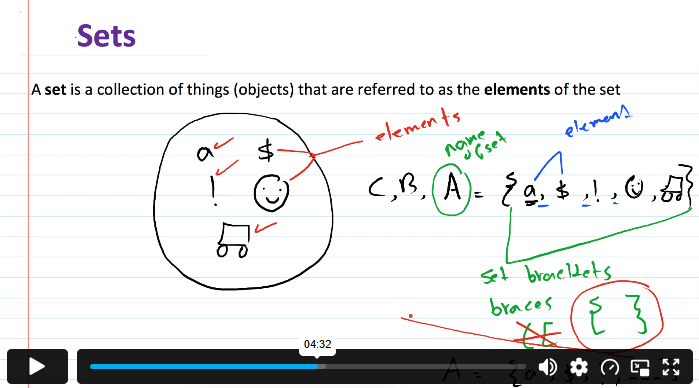
| Introduction to Sets | 00:01:00 | ||
| Definition of Set | 00:09:00 | ||
| Number Sets | 00:10:00 | ||
| Set Equality | 00:09:00 | ||
| Set-Builder Notation | 00:10:00 | ||
| Types of Sets | 00:12:00 | ||
| Subsets | 00:10:00 | ||
| Power Set | 00:05:00 | ||
| Ordered Pairs | 00:05:00 | ||
| Cartesian Products | 00:14:00 | ||
| Cartesian Plane | 00:04:00 | ||
| Venn Diagrams | 00:03:00 | ||
| Set Operations (Union, Intersection) | 00:15:00 | ||
| Properties of Union and Intersection | 00:10:00 | ||
| Set Operations (Difference, Complement) | 00:12:00 | ||
| Properties of Difference and Complement | 00:07:00 | ||
| De Morgan’s Law | 00:08:00 | ||
| Partition of Sets | 00:16:00 | ||
| Logic | |||
| Introduction | 00:01:00 | ||
| Statements | 00:07:00 | ||
| Compound Statements | 00:13:00 | ||
| Truth Tables | 00:09:00 | ||
| Examples | 00:13:00 | ||
| Logical Equivalences | 00:07:00 | ||
| Tautologies and Contradictions | 00:06:00 | ||
| De Morgan’s Laws in Logic | 00:12:00 | ||
| Logical Equivalence Laws | 00:03:00 | ||
| Conditional Statements | 00:13:00 | ||
| Negation of Conditional Statements | 00:10:00 | ||
| Converse and Inverse | 00:07:00 | ||
| Biconditional Statements | 00:09:00 | ||
| Examples | 00:12:00 | ||
| Digital Logic Circuits | 00:13:00 | ||
| Black Boxes and Gates | 00:15:00 | ||
| Boolean Expressions | 00:06:00 | ||
| Truth Tables and Circuits | 00:09:00 | ||
| Equivalent Circuits | 00:07:00 | ||
| NAND and NOR Gates | 00:07:00 | ||
| Quantified Statements – ALL | 00:08:00 | ||
| Quantified Statements – THERE EXISTS | 00:07:00 | ||
| Negations of Quantified Statements | 00:08:00 | ||
| Number Theory | |||
| Introduction | 00:01:00 | ||
| Parity | 00:13:00 | ||
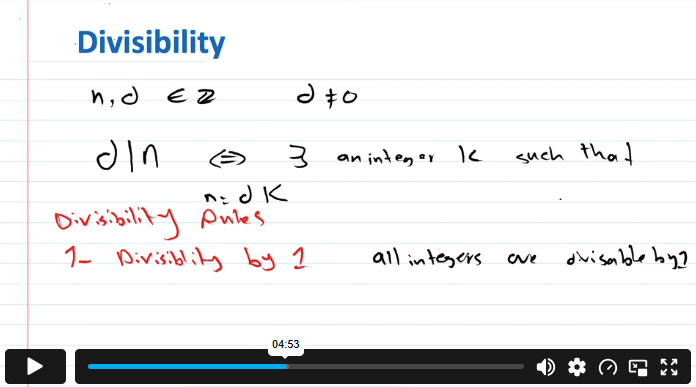
| Divisibility | 00:11:00 | ||
| Prime Numbers | 00:08:00 | ||
| Prime Factorisation | 00:09:00 | ||
| GCD & LCM | 00:17:00 | ||
| Proof | |||
| Intro | 00:06:00 | ||
| Terminologies | 00:08:00 | ||
| Direct Proofs | 00:09:00 | ||
| Proofs by Contrapositive | 00:11:00 | ||
| Proofs by Contradiction | 00:17:00 | ||
| Exhaustion Proofs | 00:14:00 | ||
| Existence & Uniqueness Proofs | 00:16:00 | ||
| Proofs by Induction | 00:12:00 | ||
| Examples | 00:19:00 | ||
| Functions | |||
| Intro | 00:01:00 | ||
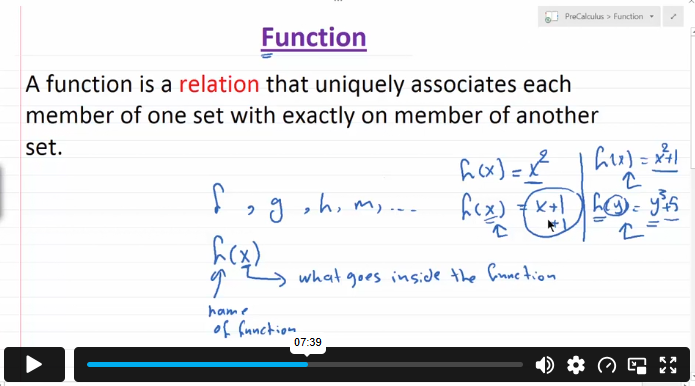
| Functions | 00:15:00 | ||
| Evaluating a Function | 00:13:00 | ||
| Domains | 00:16:00 | ||
| Range | 00:05:00 | ||
| Graphs | 00:16:00 | ||
| Graphing Calculator | 00:06:00 | ||
| Extracting Info from a Graph | 00:12:00 | ||
| Domain & Range from a Graph | 00:08:00 | ||
| Function Composition | 00:10:00 | ||
| Function Combination | 00:09:00 | ||
| Even and Odd Functions | 00:08:00 | ||
| One to One (Injective) Functions | 00:09:00 | ||
| Onto (Surjective) Functions | 00:07:00 | ||
| Inverse Functions | 00:10:00 | ||
| Long Division | 00:16:00 | ||
| Relations | |||
| Intro | 00:01:00 | ||
| The Language of Relations | 00:10:00 | ||
| Relations on Sets | 00:13:00 | ||
| The Inverse of a Relation | 00:06:00 | ||
| Reflexivity, Symmetry and Transitivity | 00:13:00 | ||
| Examples | 00:08:00 | ||
| Properties of Equality & Less Than | 00:08:00 | ||
| Equivalence Relation | 00:07:00 | ||
| Equivalence Class | 00:07:00 | ||
| Graph Theory | |||
| Intro | 00:01:00 | ||
| Graphs | 00:11:00 | ||
| Subgraphs | 00:09:00 | ||
| Degree | 00:10:00 | ||
| Sum of Degrees of Vertices Theorem | 00:23:00 | ||
| Adjacency and Incidence | 00:09:00 | ||
| Adjacency Matrix | 00:16:00 | ||
| Incidence Matrix | 00:08:00 | ||
| Isomorphism | 00:08:00 | ||
| Walks, Trails, Paths, and Circuits | 00:13:00 | ||
| Examples | 00:10:00 | ||
| Eccentricity, Diameter, and Radius | 00:07:00 | ||
| Connectedness | 00:20:00 | ||
| Euler Trails and Circuits | 00:18:00 | ||
| Fleury’s Algorithm | 00:10:00 | ||
| Hamiltonian Paths and Circuits | 00:06:00 | ||
| Ore’s Theorem | 00:14:00 | ||
| The Shortest Path Problem | 00:13:00 | ||
| Statistics | |||
| Intro | 00:01:00 | ||
| Terminologies | 00:03:00 | ||
| Mean | 00:04:00 | ||
| Median | 00:03:00 | ||
| Mode | 00:03:00 | ||
| Range | 00:08:00 | ||
| Outlier | 00:04:00 | ||
| Variance | 00:09:00 | ||
| Standard Deviation | 00:04:00 | ||
| Combinatorics | |||
| Intro | 00:03:00 | ||
| Factorials | 00:08:00 | ||
| The Fundamental Counting Principle | 00:13:00 | ||
| Permutations | 00:13:00 | ||
| Combinations | 00:12:00 | ||
| Pigeonhole Principle | 00:06:00 | ||
| Pascal’s Triangle | 00:08:00 | ||
| Sequence and Series | |||
| Intro | 00:01:00 | ||
| Sequence | 00:07:00 | ||
| Arithmetic Sequences | 00:12:00 | ||
| Geometric Sequences | 00:09:00 | ||
| Partial Sums of Arithmetic Sequences | 00:12:00 | ||
| Partial Sums of Geometric Sequences | 00:07:00 | ||
| Series | 00:13:00 | ||
| Assignment | |||
| Assignment – An Introduction to Discrete Maths | 00:00:00 | ||

1. What is discrete maths used for? +
It is used in computer science, programming, data analysis, and logical problem-solving.
2. Is this course suitable for beginners? +
Yes, it starts from basic concepts and gradually builds advanced understanding.
3. Do I need strong math skills before starting? +
Basic arithmetic knowledge is enough to begin this course.
4. How does discrete maths help in careers? +
It improves logical thinking required for software development and data-related jobs.
5. What topics are included in this course? +
It covers sets, logic, graph theory, combinatorics, and other core areas.
£24.99
Exclusive Deal! 95% Off, Today Only!
Offer Ends Soon
 Take All courses for £49

This course includes:
 Access
 Level
Level
 Number of Units
 Duration
 Course Type
- £24.99
- 1 year
- Intermediate
- Number of Units123
- Number of Quizzes0
- 18 hours, 56 minutes Gift this course
 14-Day Money-Back Guarantee
£24.99
/Unit Price
Exclusive Deal! 95% Off, Today Only!
Discounted Total:£120.00
Quantity:
Buying more than one of the same courses?
- 50% discount for orders of 10+ courses
- 60% discount for orders of 50+ courses
- 70% discount for orders of 100+ courses
Looking for a more personalised package?
Contact Us Now