

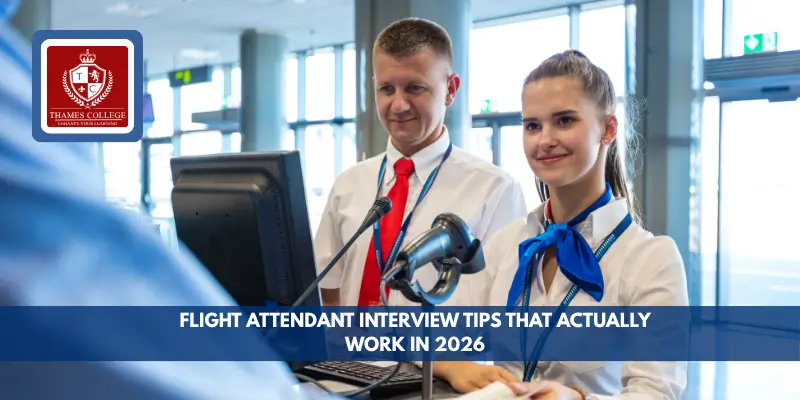
The moment you walk into a flight attendant interview, everything starts being assessed in ways most candidates don’t immediately notice. It is not only about how you answer questions, but how you present yourself before speaking, how you manage your body language, and how naturally you adapt to a professional, structured environment. Airlines are trained to observe small behavioural details, because these often reflect how someone will perform in real in-flight situations where pressure, time limits, and passenger needs all come together at once.
Many candidates believe success depends mainly on confidence or appearance, but airline recruitment in 2026 goes far deeper than surface impressions. Interview panels are evaluating communication clarity, emotional stability, teamwork behaviour, and decision-making under subtle pressure. Even simple interactions, such as how you listen, respond, or handle uncertainty, are used to understand whether you can remain composed in real operational conditions. This is because cabin crew work is not predictable; it requires calm thinking and consistent professionalism in fast-changing environments.
Most candidates do not fail due to lack of ability, but due to a mismatch between preparation and expectation. Without understanding what airlines are actually measuring, it becomes easy to focus on rehearsed answers instead of genuine behaviour. The process is designed to identify individuals who can stay natural, responsive, and reliable rather than those who simply memorise responses. This guide focuses on breaking down those expectations in a practical way, so you can understand what really matters at each stage of the interview and how to align your preparation with what airlines are looking for today.
Table of Contents
Why flight attendant interviews are so competitive
Flight attendant interviews attract a large number of applicants because the career combines travel opportunities, structured growth, and international exposure in a way few other jobs can offer. This strong appeal naturally leads to a high volume of candidates applying for limited positions, especially in well-known airlines. As a result, the selection process becomes highly competitive from the very beginning.
What makes it even more challenging is that many applicants often meet the basic requirements on paper. This means airlines must go beyond qualifications to identify the right fit. Small differences in communication style, confidence, body language, and overall professionalism start to play a major role in separating candidates. Two applicants with similar backgrounds can be judged very differently based on how they present themselves during short interactions.
In 2026, airlines are also focusing more on consistency with their brand image and passenger experience standards. Cabin crew are seen as direct representatives of the airline, which means personality, attitude, and behaviour carry as much weight as technical understanding. Recruiters are looking for individuals who can naturally align with these expectations in real operational environments.
Because of this, interviews are structured to identify clarity, adaptability, and emotional control. The process helps filter out hesitation, uncertainty, and lack of awareness about the role, ensuring that selected candidates are genuinely prepared for the demands of airline service.
What many beginners do not realise early on is that this career does not start at the application stage alone. It starts much earlier, with understanding what airlines actually expect, how the selection process works, and what kind of personal development is needed before even applying. From eligibility criteria and grooming standards to communication skills and confidence building, every stage plays a role in shaping whether a candidate moves forward or gets filtered out. Without this clarity, many people feel confused about where to begin or how to properly prepare.
This guide breaks the full journey into a clear, step-by-step path so it becomes easier to understand how everything connects. From initial requirements and training foundations to interview stages and long-term career development, each part is explained in a practical way. The aim is to give a complete picture of how aspiring candidates move from interest to becoming fully trained flight attendants ready for real airline operations.
What airlines are really looking for in 2026
Airlines have become more structured in their selection criteria.
They are no longer focused only on appearance or basic communication skills. Instead, they assess:
- Calm behaviour under pressure
- Clear and simple communication
- Natural friendliness without overacting
- Team awareness and cooperation
- Ability to follow instructions precisely
- Emotional stability in challenging situations
What matters most is not perfection, but consistency in behaviour.
Candidates who understand the role deeply and present themselves naturally tend to perform better than those trying to “act” like cabin crew.
Cabin Crew Salary Breakdown and Benefits
Salary is one of the most discussed parts of a flight attendant career, but it is also one of the most misunderstood. Earnings in this profession are not fixed in a single structure like many office jobs. Instead, they are made up of a combination of base salary, flying allowances, and additional benefits that vary depending on airline type, experience level, and route assignments.
For entry-level cabin crew, the salary usually starts at a moderate level, often ranging around $1,000 to $2,500 per month depending on the airline and country. At this stage, a significant portion of total income comes from flight hours, layover allowances, and duty-related bonuses rather than just base pay.
As experience increases, mid-level flight attendants typically see a rise in both salary and benefits, with monthly earnings often ranging between $2,500 to $4,500. Along with higher pay, crew members may receive better flight schedules, improved accommodation during layovers, and additional travel-related perks.
Senior cabin crew members, including pursers and lead attendants, can earn approximately $4,500 to $7,000+ per month in international airlines. These roles come with added responsibility, including managing the cabin crew team, overseeing passenger safety procedures, and handling in-flight coordination.
Beyond salary, one of the biggest advantages of this career is the benefits package. Many airlines offer discounted or free travel for employees, accommodation during layovers, meal allowances, and access to international routes. These benefits often add significant value beyond the monthly salary and make the overall compensation package more attractive.
Overall, cabin crew earnings grow steadily with experience, making it a career where both income and opportunities expand over time rather than remaining fixed at entry level.
First impressions and grooming standards
First impressions are formed within seconds of entering the interview space, and in airline recruitment, those early moments carry significant weight. Before any questions are asked, interviewers are already observing posture, walking style, facial expression, and overall presence. These small details help them understand how a candidate naturally presents themselves in a professional environment and how they may behave in front of passengers during real flights.
Grooming in this context is not about luxury or overly styled appearance. It is about maintaining a clean, well-organised, and airline-ready presentation. This includes neat hair, appropriate outfit choice, minimal and professional styling, and attention to overall personal hygiene. Airlines are looking for consistency and discipline in appearance because cabin crew represent the airline brand at all times while working.
Body language also plays a major role. A straight posture, steady walking pace, and calm facial expression communicate confidence without needing to say anything. Candidates who appear rushed, overly nervous, or unbalanced in their movements can unintentionally create a weaker impression, even if their answers are strong later in the interview.
A calm and composed entry often leaves a stronger impact than a rehearsed introduction. Interviewers can easily notice when behaviour feels forced, so natural confidence tends to work better than exaggerated expressions of enthusiasm. In many cases, simple and controlled presence is more effective than trying too hard to stand out.
Communication tips that make you stand out
Communication is one of the most important evaluation areas in flight attendant interviews because it reflects how a candidate will interact with passengers and crew in real operational settings. Airlines are not only listening to what is said, but also how it is delivered, including tone, clarity, and natural flow of speech.
Strong candidates speak:
- Clearly without rushing
- Calmly without overthinking
- Naturally without memorising answers
Strong communication in this context is not about using complex vocabulary or memorised responses. It is about expressing ideas in a clear, simple, and confident way. Candidates who speak in a steady pace, avoid rushing, and maintain a calm tone often come across as more reliable and professional. This helps interviewers understand that they can handle real passenger interactions without confusion or pressure.
Good candidates also show balance between speaking and listening. Interviews are not one-sided conversations; they often include follow-up questions, group discussions, or situational prompts. Listening carefully before responding shows awareness and respect, which are important qualities in a cabin crew environment where instructions and communication must be understood accurately.
One useful approach is to structure answers in a simple flow rather than overthinking or adding unnecessary detail. A clear beginning, a focused explanation, and a short conclusion are usually enough to deliver a strong response. This keeps communication natural and easy to follow, while also showing confidence and control during the conversation.
Group discussion strategies that actually work
Group discussions are designed to observe teamwork, not dominance.
Many candidates believe speaking the most increases chances of selection. In reality, quality matters more than quantity.
Successful candidates:
- Listen actively
- Build on others’ ideas
- Speak at the right moment
- Avoid interrupting
- Stay calm even if others are competitive
Airlines are looking for individuals who can work in a team during real flights, not individuals who dominate conversations.
Balance is key here.
Common interview questions and how to handle them
Most flight attendant interviews follow similar question patterns because airlines are not only checking knowledge, but also personality, awareness of the role, and real-life behaviour under pressure. These questions are designed to reveal how a candidate thinks, reacts, and communicates in situations that closely reflect actual cabin crew responsibilities.
Some of the most common areas include questions about motivation, teamwork, passenger handling, and emergency awareness. For example, when asked why you want to become cabin crew, interviewers are not looking for a “perfect” answer, but for a clear understanding of the role beyond surface-level interest. Candidates who connect their answer to responsibility, service mindset, and interest in structured teamwork usually perform better than those focusing only on travel or lifestyle.
Questions about difficult passengers are used to assess emotional control and problem-solving ability. In real flights, cabin crew deal with a variety of passenger behaviours, so airlines want to see whether candidates can stay calm, listen carefully, and respond professionally without escalation. Similarly, teamwork questions help recruiters understand how well a candidate can work in coordination with others, since cabin crew operate as a team where communication and cooperation are essential.
Emergency-related questions are not designed to test technical knowledge alone but to evaluate calm thinking and decision-making under pressure. Even a simple structured response showing awareness, safety priority, and logical action can create a strong impression.
The most effective responses are not memorised scripts. Instead, they are structured, natural, and based on real understanding of behaviour and responsibility. Interviewers can usually recognise rehearsed answers quickly, so candidates who speak honestly, stay composed, and keep their responses clear tend to stand out more in a real selection environment.
Personality and attitude airlines prefer
Group discussions are designed to observe teamwork, not dominance.
Many candidates believe speaking the most increases chances of selection. In reality, quality matters more than quantity.
Successful candidates:
- Listen actively
- Build on others’ ideas
- Speak at the right moment
- Avoid interrupting
- Stay calm even if others are competitive
Airlines are looking for individuals who can work in a team during real flights, not individuals who dominate conversations.
Balance is key here.
Common interview questions and how to handle them
Most flight attendant interviews follow similar question patterns because airlines are not only checking knowledge, but also personality, awareness of the role, and real-life behaviour under pressure. These questions are designed to reveal how a candidate thinks, reacts, and communicates in situations that closely reflect actual cabin crew responsibilities.
Some of the most common areas include questions about motivation, teamwork, passenger handling, and emergency awareness. For example, when asked why you want to become cabin crew, interviewers are not looking for a “perfect” answer, but for a clear understanding of the role beyond surface-level interest. Candidates who connect their answer to responsibility, service mindset, and interest in structured teamwork usually perform better than those focusing only on travel or lifestyle.
Questions about difficult passengers are used to assess emotional control and problem-solving ability. In real flights, cabin crew deal with a variety of passenger behaviours, so airlines want to see whether candidates can stay calm, listen carefully, and respond professionally without escalation. Similarly, teamwork questions help recruiters understand how well a candidate can work in coordination with others, since cabin crew operate as a team where communication and cooperation are essential.
Emergency-related questions are not designed to test technical knowledge alone but to evaluate calm thinking and decision-making under pressure. Even a simple structured response showing awareness, safety priority, and logical action can create a strong impression.
The most effective responses are not memorised scripts. Instead, they are structured, natural, and based on real understanding of behaviour and responsibility. Interviewers can usually recognise rehearsed answers quickly, so candidates who speak honestly, stay composed, and keep their responses clear tend to stand out more in a real selection environment.
Personality and attitude airlines prefer
Airlines prioritise personality over technical knowledge at the selection stage because skills can be trained later, but attitude and behaviour are harder to develop quickly. They are looking for candidates who can naturally fit into a structured, service-driven environment while maintaining consistency under pressure.
They typically look for:
➽Positivity without overconfidence
A positive mindset that feels natural and steady, not forced or overly expressive. Candidates who stay balanced and realistic tend to create a stronger impression.
➽Respectful communication style
Speaking politely, listening carefully, and responding in a way that shows professionalism and awareness of different people and situations.
➽Emotional control in pressure situations
The ability to stay calm when faced with delays, passenger issues, or unexpected changes. Airlines value stability more than fast reactions.
➽Adaptability to different environments
Being open to changing schedules, diverse passengers, and varying working conditions without resistance or discomfort.
➽A service mindset without exaggeration
Showing genuine willingness to help and support passengers in a natural way, rather than acting overly enthusiastic or unnatural.
The overall goal is not to appear perfect, but to appear dependable and consistent in real operational situations. A calm, grounded personality often performs better than an overly energetic or overly rehearsed presence, especially when assessed in group discussions or one-to-one interviews.
Mistakes that instantly reduce your chances
Many candidates lose flight attendant interview opportunities not because they are unqualified, but because of small mistakes that signal lack of preparation or awareness. Airlines observe behaviour closely, and even minor issues in communication or attitude can create a weaker overall impression during the selection process.
Some of the most common mistakes include:
➽Over-rehearsed answers that sound unnatural
When responses feel memorised, they lose authenticity. Interviewers prefer natural communication because it reflects how a candidate will behave in real passenger interactions.
➽Poor eye contact or nervous body language
Avoiding eye contact, fidgeting, or appearing overly tense can signal low confidence. Airlines expect steady presence and calm physical behaviour under observation.
➽Ignoring group discussion etiquette
Group activities are used to assess teamwork, not dominance. Interrupting others, speaking over teammates, or failing to listen properly can reduce chances significantly.
➽Speaking too fast under pressure
Nervous speed in speech often affects clarity. Clear, steady communication is more important than trying to say too much quickly.
➽Lack of awareness about the roleCandidates who do not fully understand cabin crew responsibilities often struggle to answer situational questions effectively, which raises concerns about readiness.
Another major issue is having a limited understanding of what the job actually involves. Many candidates focus mainly on travel, lifestyle, or external appeal, but airlines are primarily looking for individuals who understand safety responsibility, passenger care, and operational discipline.
Overall, awareness, behaviour, and clarity of understanding matter just as much as confidence. Candidates who prepare with a realistic view of the role and avoid these common mistakes are far more likely to perform well in interviews.
Final preparation checklist before interview day
Before attending an interview, preparation should be both mental and practical.
Candidates should:
- Understand the role clearly
- Practice simple communication
- Maintain professional grooming
- Stay calm and well-rested
- Review basic airline expectations
Confidence on interview day does not come from memorisation. It comes from preparation and clarity.
A steady mindset often creates a stronger impression than perfect answers.
FAQs
Clear communication, calm behaviour, and understanding of the cabin crew role are the most important factors. Airlines focus more on attitude than memorised answers.
Focus on communication practice, grooming, and basic knowledge of airline responsibilities. Mock interviews also help build confidence.
No, perfect English is not required. Clear, confident, and understandable communication is more important than advanced vocabulary.
Wear clean, formal, and professional clothing that reflects a neat airline-ready appearance. Simple grooming is always preferred.
Yes, group discussions help airlines assess teamwork, listening skills, and communication style. Cooperation matters more than dominance
Practice speaking clearly, maintain good posture, and prepare basic answers about the role. Regular practice reduces nervousness.
Questions usually focus on motivation, teamwork, passenger handling, and emergency awareness. They test behaviour, not just knowledge.
Yes, many airlines accept fresh candidates. Training is provided after selection for successful applicants
The biggest mistake is focusing only on travel and lifestyle instead of understanding safety and responsibility aspects of the job
It varies by airline, but it can take from a single day assessment to multiple rounds over a few weeks depending on the recruitment stage.
Still searching for the right course? View All Courses NOW


- All courses
- QLS Endorsed Single Course683
- Management Courses329
- Technology Courses322
- Mega Bundles269
- Business Courses237
- Health Courses213
- Teaching Courses201
- Professional & Personal Growth196
- Creative Courses95
- Law Courses85
- Marketing Courses77
- Counselling Courses71
- Engineering Courses53
- Job Guarantee Programme50
- Arts Courses37
- 4-in-1 bundle32
- QLS Endorsed Single Course with Free Certificate27
- Science Courses26
- Agriculture Courses22
- Regulated Courses7
- Psychology2