
When your thoughts are racing, putting your feelings into words can be surprisingly difficult. Sometimes, a pencil, a few colours or a piece of clay offers another way to express what’s on your mind.
Art therapy for anxiety may help people express difficult emotions, reflect on their experiences and engage with feelings through creative work. Research into professionally delivered art therapy shows promising findings, although results vary. Simple activities such as drawing, colouring and journalling can also offer enjoyable opportunities for relaxation and self-expression.
You don’t need artistic talent or expensive supplies to get started. Here are six creative activities worth trying, alongside what research says and when professional support may be helpful.
Table of Contents
Discover Art Therapy Certification Diploma
Mindfulness, creative expression, drawing and reflective writing in one broad introduction.
Can Art Therapy Help with Anxiety?
Art therapy can help some people experiencing anxiety by providing a creative way to express thoughts and feelings that may be difficult to communicate verbally.
In professional art therapy, a qualified therapist uses creative activities within a therapeutic relationship. The emphasis is on personal expression and reflection rather than artistic ability.
Research suggests potential benefits. A systematic review of art therapy for anxiety in adults examined three randomised trials involving 162 participants. Although some findings were encouraging, the researchers identified limitations in study quality and concluded that stronger evidence was needed.
Looking more broadly at research on the benefits of art therapy can provide further context for its possible applications.
The distinction matters: professional art therapy is a psychological intervention, while drawing or colouring independently is a creative wellbeing activity.
Both can offer meaningful experiences, but their purposes and supporting evidence differ.
How Can Creative Activities Support People with Anxiety?
Creative activities give your attention somewhere to settle. Instead of concentrating entirely on worries, you can spend time noticing colours, shapes, textures and movements.
Three aspects may be particularly appealing:
- Focused attention: Repeating simple patterns or drawing lines encourages you to concentrate on the task in front of you.
- Emotional expression: Colours and images can help represent feelings that are difficult to describe.
- Personal reflection: Creating something allows you to notice your thoughts without having to reach an immediate conclusion.
Professional art therapists may use more structured techniques for creative emotional expression according to individual therapeutic needs.
Learners interested in the connection between thoughts, emotions and creativity can study the psychology behind art-based approaches in more detail.
For example, someone who enjoys structure might prefer colouring patterns, while someone who wants to express emotions may enjoy painting freely.
There is no single activity that suits everyone. The best starting point is something that feels approachable and interesting.
6 Art Therapy Activities for Anxiety You Can Try at Home
These six self-guided creative exercises require only basic materials. Choose an activity that appeals to you, and enjoy the process without worrying about the finished result.
1. Mindful Line Drawing
Best for: Giving busy thoughts a simple point of focus.
You will need: Paper and a pencil.

Start drawing one continuous line across your page. Let it curve, loop or change direction naturally.
Notice the movement of your hand and the marks appearing on the paper. You could create repeating waves, spirals or overlapping shapes.
If your attention wanders, simply return to the movement of the pencil.
Try this: Draw slowly for three minutes, then look at the different shapes you’ve created.
The activity gives you a straightforward task to concentrate on, without needing to plan an image.
2. Simple Pattern or Mandala Colouring
Best for: People who enjoy repetition and structure.
You will need: Coloured pencils and a simple pattern.
Draw several circles, squares or repeating shapes. Alternatively, print a mandala colouring sheet.
Choose two or three colours and gradually fill the spaces. Notice how each colour changes the overall design.
You can follow a consistent pattern or experiment with different combinations.
Try this: Focus on completing one small section rather than the entire page.
Repeating familiar movements may make the activity feel more manageable when concentrating is difficult.
3. Colour Your Feelings
Best for: Expressing emotions without relying entirely on words.
You will need: Crayons, coloured pencils or paint.
Think about how you’re feeling at the moment. Choose colours, shapes or lines that seem to represent those feelings.
You might create broad brushstrokes, small circles or overlapping patches of colour.
There are no rules about which colours represent particular emotions. Their meanings are personal.
Try this: When you finish, ask yourself, “What does this picture express about how I’m feeling today?”
You can keep your artwork private or use it as a starting point for conversation.
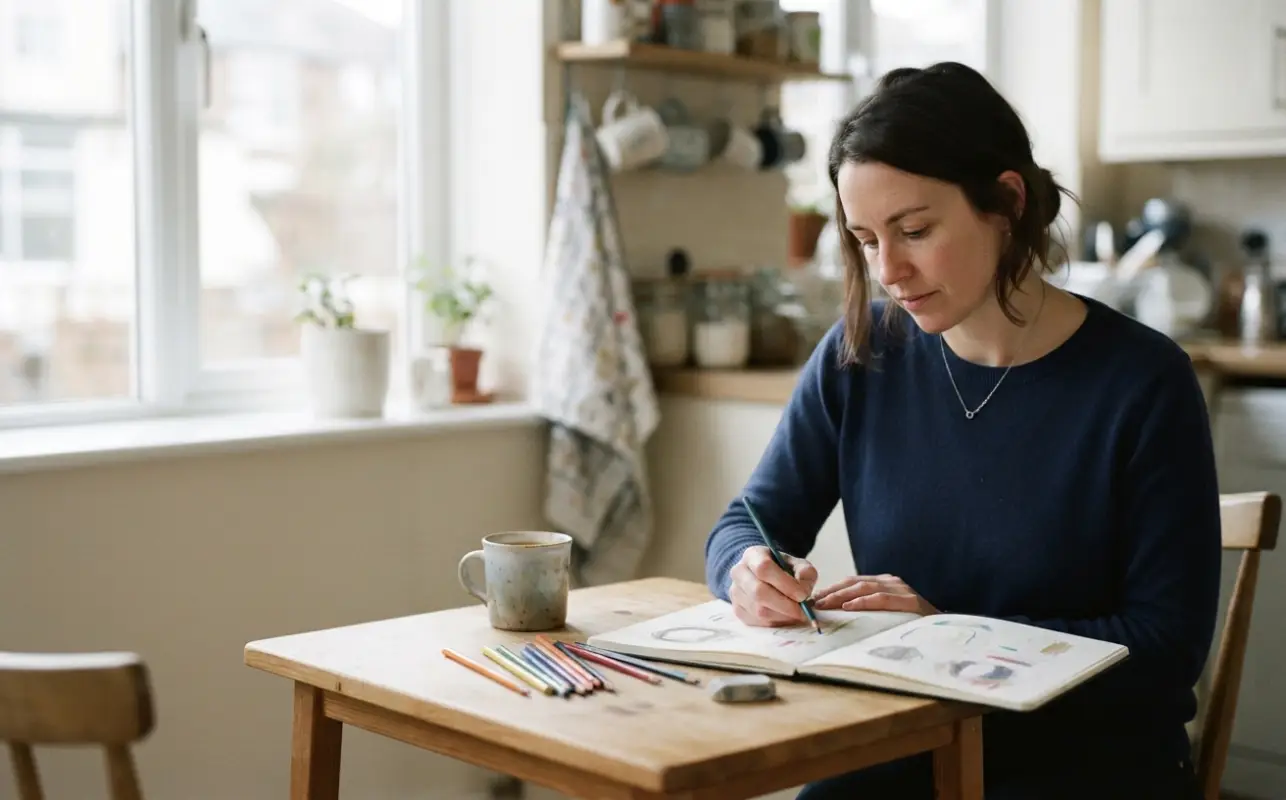
4. Draw and Journal Your Thoughts
Best for: Reflecting on everyday experiences and worries.
You will need: A notebook and pen or pencils.

Begin with a small drawing that represents something from your day. It could be a simple object, an abstract shape or a scene you remember.
Underneath, write a few words about what the image means to you.
Consider these prompts:
- What feeling stood out today?
- What helped me feel comfortable?
- What would I like to make time for tomorrow?
You don’t have to answer every question.
Try this: Keep one page for each day you choose to practise. Over time, you may notice recurring themes or interests.
If you enjoy combining images with written reflection, art and journalling practices offer another subject to study in greater depth.
5. Make a Comforting Collage
Best for: Bringing together images associated with pleasant experiences.
You will need: Coloured paper, old magazines, scissors and glue.
Collect pictures, textures or colours that remind you of enjoyable places, hobbies or meaningful memories.
Arrange everything on a sheet of paper before sticking the pieces down.
Your collage might feature gardens, favourite colours, books or places you’d like to visit.
Try this: Choose one image and consider what makes it personally reassuring or enjoyable.
Collage-making offers freedom to create something meaningful without needing drawing skills.
6. Shape Something with Clay
Best for: People who enjoy hands-on, tactile activities.
You will need: Modelling dough or air-drying clay.
Take a small piece of clay and gently roll it between your hands.
Flatten, stretch or reshape it into something simple, such as a smooth stone, small bowl or abstract sculpture.
Pay attention to its texture, weight and changing shape.
Try this: Create three different shapes using the same piece of clay.
Working with a physical material gives you something tangible to concentrate on. If you prefer not to use clay, another drawing activity may suit you better.
If you’d like more inspiration, there are plenty of creative activities for adults and children that can be adapted to different interests and abilities.

How to Try Creative Activities at Home
Making time for creativity doesn’t require a complicated routine.
Start with one activity and spend a few minutes experimenting. Keep your materials somewhere convenient, such as beside a notebook or on a small desk.
Choose a comfortable environment where you can work without unnecessary interruptions.
Remember that the process matters more than the appearance of your artwork. You can change direction, leave something unfinished or return to it another day.
If an exercise brings up uncomfortable feelings, take a break or choose something less emotionally demanding.
Most importantly, let creativity remain an enjoyable choice rather than another task on your daily to-do list.
When Should You Consider Professional Art Therapy?
Creative activities can be part of a personal wellbeing routine, while professional art therapy offers structured support for exploring emotions and experiences.
A registered art therapist works with people using creative expression within an established therapeutic relationship. Sessions may involve drawing, painting or other materials, alongside opportunities to reflect on the artwork.
Creative approaches can also be adapted for younger people, particularly when supporting children’s emotional expression through art.

In the UK, art therapist and art psychotherapist are protected professional titles under HCPC regulation. You can check a practitioner’s registration through the HCPC Register.
If anxiety regularly affects your daily life, sleep, relationships or ability to manage everyday responsibilities, professional support may be beneficial.
The NHS provides guidance on anxiety, fear and panic, including when to speak to your GP.
Eligible people aged 18 and over in England can also refer themselves to NHS Talking Therapies. Some services accept 16- and 17-year-olds. These services provide established psychological treatments for anxiety and depression.
Discover Art Therapy Certification Diploma
Mindfulness, creative expression, drawing and reflective writing in one broad introduction.
Developing Your Knowledge of Art Therapy
If you’re interested in how creativity connects with emotional wellbeing, further study can introduce you to the principles behind different art-based approaches.
Anyone considering a professional career should also check the qualifications needed to become an art therapist in the UK.
If you’re considering studying the subject further, looking at how creativity connects with art therapy careers can help you see the wider professional context.
Beginners considering further study may benefit from knowing what to expect when starting art therapy training.
For a broader introduction to creative wellbeing, Thames College’s Art Therapy Certification Diploma covers mindfulness, creative expression, drawing and reflective writing.
The self-paced online course includes CPD and QLS certificate options. It is designed to develop relevant knowledge rather than provide the professional qualification required for HCPC registration as an art therapist.
Another option for continuing your studies is Thames College’s Art Therapy for Emotional Wellbeing, which introduces mindful creativity, emotional expression and reflective activities.
Final Thoughts
Art therapy for anxiety offers opportunities for emotional expression and reflection, while everyday creative activities can bring moments of focus and enjoyment into your routine.
Whether you prefer drawing, colouring or working with clay, begin with something that interests you. A few marks on a page can be a simple, meaningful place to start.
Frequently Asked Questions
Not at all. Creative activities focus on expression and personal experience rather than technical ability. Simple shapes, colours and patterns are enough to get started.
There’s no fixed duration. You could begin with five or ten minutes and adjust the time according to your interests and comfort.
Art therapy may form part of a professional treatment plan, depending on individual needs. Self-guided creative activities should not replace treatment recommended by a healthcare professional.
Occasionally, reflecting on difficult emotions can feel uncomfortable. You can stop, try a simpler activity or speak with a qualified professional if you need further support.
Mindful line drawing and simple colouring are accessible starting points. Both require minimal materials and allow you to concentrate on the creative process without planning a complex picture.
Mindful drawing, pattern colouring, journalling and clay shaping are simple creative activities you can try at home. Gentle breathing exercises and grounding techniques may also help you manage anxious feelings. Choose something that feels comfortable and allows you to focus on the present moment.
Spending ten minutes drawing may help you redirect your attention from worrying thoughts towards a creative task. Try sketching repeated lines, colouring simple shapes or making abstract patterns. Although drawing may feel calming, there is no established evidence that ten minutes of drawing automatically resets your nervous system.
Slow breathing and grounding exercises may help when anxiety feels overwhelming. The NHS recommends gentle breathing exercises for stress, anxiety and panic. You could also try mindful line drawing or colouring to give your attention a simple, manageable task.
There is no single activity that works best for everyone. Some people prefer walking, breathing exercises or physical activity, while others enjoy drawing, colouring or journalling. If you prefer creative activities, start with mindful line drawing or pattern colouring and see which feels most comfortable.