
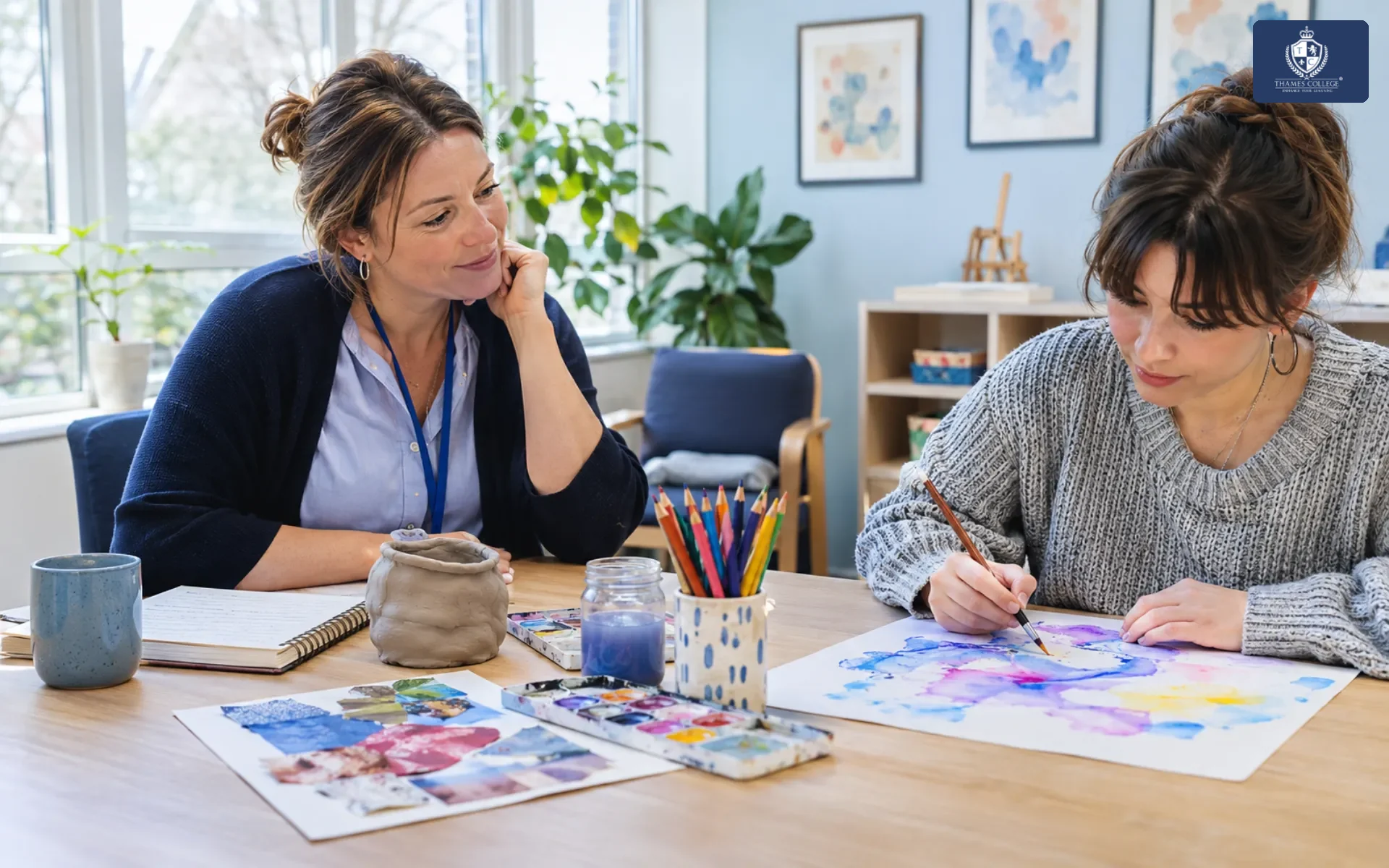
A blank sheet of paper, a lump of clay or a collection of photographs might seem like ordinary art materials. In art therapy, however, they can become ways of communicating thoughts and experiences that are difficult to put into words.
Art therapy techniques are creative methods used within psychotherapy to support emotional expression, communication and reflection. Common approaches include drawing, painting, collage, sculpture, self-portraits and visual storytelling. Qualified practitioners select techniques according to each person’s needs, preferences and therapeutic goals.
But not every technique works in the same way. Understanding how practitioners use different materials helps explain what makes art therapy more than simply making art.
Table of Contents
What Are Art Therapy Techniques?
Art therapy techniques involve using visual art materials and creative processes within a professional therapeutic relationship.
According to the British Association of Art Therapists (BAAT), art therapy is a form of psychotherapy in which art is the primary means of expression, alongside communication with a trained therapist.
Some approaches are directive, meaning the therapist suggests a particular activity or theme. Others are non-directive, allowing the individual greater freedom to choose materials and create whatever feels meaningful.
Our article explaining what art therapy is provides a broader understanding of the therapeutic process and who it may support.
For adults interested in studying these approaches, Thames College’s Art Therapy Certification Diploma covers art therapy principles, creative techniques, mindfulness and reflective practices.
12 Art Therapy Techniques Practitioners Use

The following 12 art therapy techniques illustrate different ways practitioners may use visual materials to support therapeutic work. They are not an official list of prescribed treatments, and their suitability depends on individual assessment.
1. Free Drawing and Spontaneous Mark-Making
Free drawing allows individuals to create images without following a predetermined subject or design.
A practitioner might offer pencils, charcoal or pastels and invite someone to draw whatever comes to mind. The resulting marks, shapes or images can provide a starting point for reflection.
This approach may be useful when someone prefers open-ended expression rather than a structured task.
Importantly, a therapist should not assume that particular marks or drawing styles reveal a specific psychological condition.
2. Painting and Colour Exploration
Painting offers opportunities to express experiences through colour, movement, texture and imagery.
Practitioners may use watercolours, acrylic paints or other suitable materials, depending on the setting and the individual’s preferences.
For example, someone might create an abstract painting representing how a recent experience felt.
The therapist may then invite discussion about the creative process and what the finished image means to its creator.
Colour meanings are personal, so therapists should avoid automatically associating particular colours with specific emotions.
3. Clay Modelling and Sculpture
Clay modelling introduces a three-dimensional element to art therapy.
Instead of drawing an image, individuals can shape, press, roll or sculpt materials into objects that represent experiences, feelings or personal ideas.
A practitioner might invite someone to create an object representing something important to them.
Working with clay also offers a different sensory experience from painting or drawing.
However, therapists must consider physical accessibility, material safety and individual sensory preferences before selecting this technique.
4. Collage and Image Selection
Collage involves arranging photographs, magazine cuttings, coloured paper and other visual materials into a new composition.
It can provide another way to communicate when someone finds it difficult to begin with a blank page.
For example, a practitioner might invite a person to select images connected with an important life experience.
The individual can decide which images to include and what they represent.
This method encourages personal choice and reflection without requiring advanced drawing skills.
5. Self-Portraits and Identity Artwork
Self-portrait work allows individuals to represent themselves through realistic or abstract images.
A self-portrait does not need to resemble a traditional drawing of someone’s face. It could include colours, symbols or objects that reflect personal interests and experiences.
Practitioners may use this technique when exploring identity, relationships or changes in self-perception.
For instance, someone might create separate images showing how they view themselves in different environments.
The therapist should respect personal boundaries and avoid imposing interpretations on the artwork.
6. Mask Making
Mask making provides a creative way to consider different aspects of identity and personal expression.
A practitioner may invite someone to decorate a mask using paint, collage materials or other accessible media.
The person might choose to represent how they feel in particular situations or how they wish to present themselves.
However, a mask does not necessarily represent hidden emotions or psychological difficulties.
The individual’s own interpretation matters more than any assumed symbolism. Participation should remain voluntary and sensitive to personal comfort.
7. Mandala and Pattern Creation
Mandala drawing involves creating circular designs, while other pattern-based approaches use repeated lines, shapes or visual arrangements.
These structured art therapy methods may provide a starting point for people who prefer having a clear visual task.
A practitioner might invite someone to create a personal pattern and reflect on their experience of making it.
The emphasis remains on the creative process rather than producing a symmetrical or perfect design.
Mandala work should be approached with cultural awareness and without promising that repetitive drawing will automatically reduce distress.
8. Art Journalling

Art journalling combines drawings, paintings, photographs and sometimes written reflections in a notebook or journal.
Practitioners may use this approach to support ongoing reflection across several sessions.
For example, someone might create images connected with important events and later consider how their perspectives have changed.
Writing is optional. Individuals can communicate entirely through visual materials if they prefer.
Privacy is particularly important because journals may contain sensitive personal information.
For readers particularly interested in combining visual expression with reflective writing, Thames College’s Healing Through Creativity: Art & Journal Therapy for Self-Discovery covers mindfulness-based drawing, journalling and creative self-reflection.
9. Guided Imagery and Safe-Place Drawing
Guided imagery involves imagining a scene or experience and representing it through artwork.
A practitioner might invite someone to picture a personally meaningful place and draw the details they associate with it.
The creative process can provide opportunities to discuss feelings, memories or personal sources of comfort.
However, imagery-based approaches are not suitable for everyone. Therapists should consider individual experiences, particularly when trauma-related difficulties are involved.
Our article on art therapy for anxiety examines related creative approaches and their potential applications in more detail.
10. Visual Storytelling
Visual storytelling uses drawings, images or illustrated sequences to communicate experiences.
A practitioner might invite someone to create several pictures representing a significant event, relationship or personal journey.
This can offer another form of communication when spoken explanations feel difficult.
For example, a person could illustrate a challenging transition using a sequence of simple images.
The therapist may support reflection on the story without deciding what each image should mean.
11. Shared or Response Art-Making
Some art therapy approaches involve creative interaction between the therapist and the individual.
In shared art-making, both may contribute to a creative process where this is appropriate and agreed.
Response art can also involve a therapist creating artwork in response to therapeutic experiences as part of professional reflective practice.
These approaches require careful attention to boundaries, consent and the client’s autonomy.
The aim is not for the therapist to take control of the artwork but to support an appropriate therapeutic relationship.
12. Photography and Digital Art
Contemporary art therapy may incorporate photographs, digital drawing tools and other visual technologies.
Individuals might select meaningful photographs, create digital compositions or use images to communicate personal experiences.
For someone with limited movement, accessible digital tools may offer an alternative to traditional materials.
Practitioners must consider consent, confidentiality, accessibility and how digital artwork is stored.
Although technology expands creative possibilities, using a digital art application independently is not automatically professional art therapy.
How Do Art Therapists Choose the Right Technique?
There is no single technique that suits every person or therapeutic situation.
Qualified art therapists consider individual needs, communication preferences, creative interests and the purpose of therapy before selecting an approach.
| Consideration | Possible practitioner response |
|---|---|
| Communication preferences | Offer visual storytelling or collage |
| Sensory sensitivities | Provide alternatives to tactile materials |
| Physical accessibility | Adapt tools or use digital media |
| Preference for structure | Introduce a guided creative prompt |
| Preference for independence | Allow open-ended drawing or painting |

Practitioners may also move between directive and non-directive approaches as therapeutic work progresses.
A systematic narrative review of art therapy interventions found that therapists used varied materials and combinations of directive and non-directive behaviour. The findings highlight the importance of adapting approaches rather than relying on one method for everyone.
The benefits of art therapy also depend on factors beyond the materials selected, including individual circumstances and the therapeutic relationship. Our dedicated research article examines these considerations in more detail.
How Are Art Therapy Techniques Adapted for Different People?

Art therapy techniques can be adapted across different ages, abilities and support settings.
For children, practitioners may consider developmental stages, attention, communication and sensory preferences. Our guide to art therapy for children explains how these considerations relate to younger people’s emotional wellbeing.
Creative approaches involving play may also be relevant in child-focused support, although play therapy is a distinct therapeutic discipline. Thames College’s standalone Play Therapy course introduces therapeutic play models, supportive play environments and approaches to children’s emotional needs.
Adults may prefer reflective approaches such as journalling, self-portraits or personal storytelling.
Accessibility also matters. In its account of art therapy at Treloar’s, the UK specialist education provider describes adapting creative work for young people with complex disabilities.
Care settings may require additional consideration of physical ability, communication and individual preferences. Our article on art therapy for dementia examines creative approaches within dementia care.
The objective is always to adapt the approach to the person, rather than expecting the person to adapt to a particular technique.
Art Therapy Techniques vs Creative Activities at Home
Drawing, painting and journalling can be enjoyable ways to express feelings outside professional therapy.
However, art therapy techniques and everyday creative activities are not the same thing.
Professional art therapy involves assessment, therapeutic goals, a qualified practitioner and an established therapeutic relationship.
Someone painting at home may experience enjoyment or personal reflection, but this does not automatically make the activity a psychological treatment.
Parents, teachers and individuals seeking non-clinical inspiration can refer to our collection of art therapy activities for adults and children, which focuses on creative ideas rather than professional interventions.
Creative wellbeing activities can have value in their own right without being presented as clinical therapy.
What Qualifications Are Needed to Practise Art Therapy in the UK?
In the UK, art therapist and art psychotherapist are legally protected professional titles.
Practitioners using these titles must be registered with the Health and Care Professions Council (HCPC).
The BAAT guidance on becoming an art therapist explains that the professional route involves completing HCPC-approved master’s-level training and obtaining registration.
Understanding creative techniques through a short course is not equivalent to qualifying as a registered art therapist.
Readers considering this profession can review our guide to becoming an art therapist without a degree, which discusses UK entry requirements and professional training routes.
Final Thoughts: Understanding Art Therapy Techniques
Art therapy techniques offer different ways to express experiences through creative materials. Drawing, painting, clay modelling and visual storytelling can all play a part, but their value depends on individual needs, therapeutic goals and professional judgement.
For adults interested in developing their understanding of creative approaches, Thames College’s Art Therapy Certification Diploma covers art therapy techniques and applications, mindfulness, drawing and reflective writing. The course offers CPD and QLS certificate options.
It supports subject knowledge and creative wellbeing education but does not replace the HCPC-approved training and registration required to practise as an art therapist in the UK.
Frequently Asked Questions
Common approaches include drawing, painting, collage, clay modelling, self-portraits and visual storytelling. Practitioners may also use art journalling, mask making and digital media. The appropriate choice depends on the individual and the therapeutic purpose.
Directive art therapy involves the therapist suggesting a particular task, material or theme. Non-directive approaches provide greater freedom to choose what to create. Practitioners may combine both approaches according to individual needs.
No. Art therapy focuses on creative expression, reflection and the therapeutic process rather than artistic skill. People can participate without previous drawing, painting or sculpting experience.
You can use drawing, painting, journalling and other creative activities independently. However, practising these activities at home is not equivalent to receiving professional art therapy from a registered practitioner.
Art therapists may help individuals reflect on their artwork, but they do not rely on fixed meanings for particular colours, images or symbols. The creator’s experiences and personal interpretations are central to understanding the work.